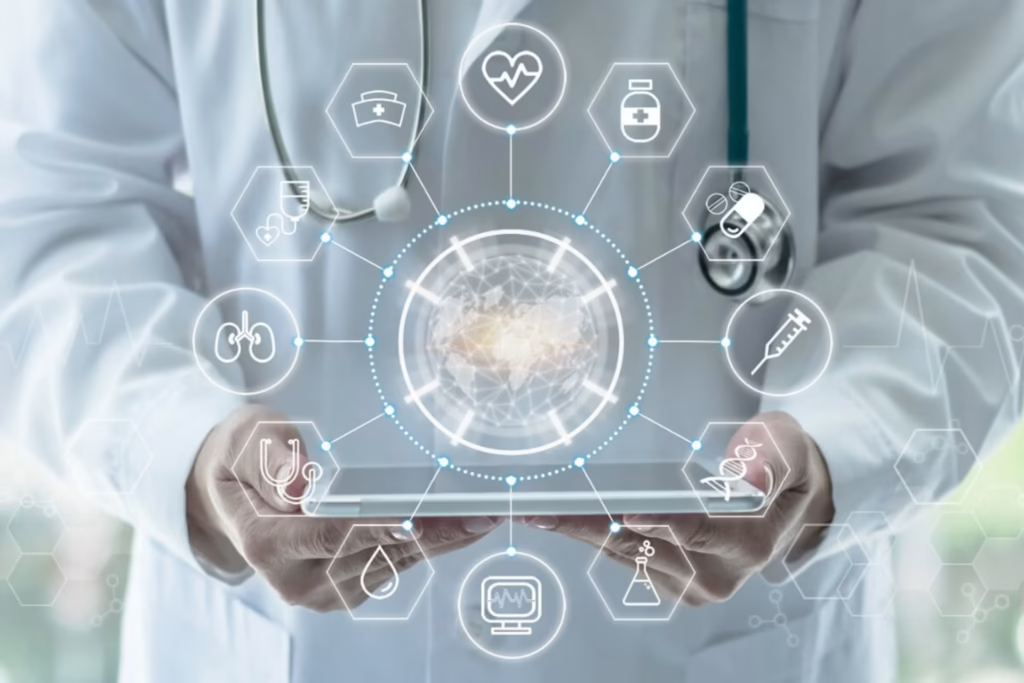

Interoperability of healthcare (the sharing, integration, and availability of patient data across disparate systems) is fundamental to quality of care, safety, and innovation. Yet while many healthcare organizations struggle to deliver interoperability, they face significant challenges. These include piecemeal electronic health record systems, legacy software, and an endless stream of regulatory requirements. Meanwhile, as data volume grows globally and as medical devices and the Internet-of-Things (IoT) proliferate, the risk of silos of information increases. This is where innovative technology can help: by leveraging the use of Blockchain and IoT together to tear down data silos and allow for secure, real-time, and standardized data exchange.
The first step in achieving true interoperability is partnership. A blockchain and IoT development company can build integrated infrastructures that connect distributed sensor networks, with blockchain-assured data, and interoperable APIs to allow providers, payors, innovators and patients to share information in a trustworthy and secure fashion.
Understanding Healthcare Interoperability and Its Challenges
Healthcare interoperability enables a smooth flow of patient information from hospitals to clinics, payers, pharmacies, and patients themselves. Interoperability enhances coordinated care, accuracy of diagnostics, reduces duplication, and provides better outcomes. That said, there are still persistent challenges that stall interoperability:
- Incompatible EHR systems: Many hospitals are often leveraging proprietary software that does not allow communication between each other’s systems.
- Lack of data standards: There can be different formats and coding for anything from records, to prescriptions, to images, to outputs from IoT devices that confuse and fail to translate a complete picture of care.
- Data privacy and security risks: The more sensitive health information is shared without protective measures, the greater the risk of being compromised or non-compliant.
- Regulatory complexity: Compliance (HIPAA, GDPR, etc. ) can make secure, multi-system integration overwhelming to execute.
- Missing IoT value: Information produced in massive quantities by wearables, monitors and smart devices may still not be accessed or remain in one app.
Not only does fragmented data inhibit continuity of care, but it contributes to preventable deaths, repeat surgeries, inefficiency, and unnecessary costs.
The Transformative Role of IoT in Healthcare Data Exchange
The Internet of Things helps address some of the difficulty by connecting medical devices, sensors, and applications in real time. Wearable trackers, remote monitors, smart beds, and laboratory equipment can generate and communicate health status, vitals, diagnostics, and alerts.
Ultimately, however, without a common framework for IoT’s use, a vast amount of data generated from tens of thousands of devices could still end up trapped within their respective proprietary ecosystems. In order to enable IoT to have impact and develop around potential, standards are required to enable data formats, data transmission, and open APIs across healthcare.
Blockchain: The Enabler of Safe, Interoperable Healthcare
Blockchain offers unique capabilities for healthcare interoperability:
- Decentralized: Patients’ data will not be stored in one central repository but rather distributed to authorized parties securely.
- Immutable and Secure: Once a patient’s record is added, it cannot be changed or erased, meaning that it is both verifiable and trustworthy over time.
- Smart contracts: Certain policies can be automatically enacted (e.g., when a doctor would have access to test results). Access to the data will always be limited to the right group of people at the right time.
- Tamper-proof identity verification: All providers, devices, and patients can be assigned unique and verifiable identities.
- Transparency: All stakeholders can track who accessed which records, which means accountability and compliance with regulatory requirements will be maintained.
When combined, blockchain provides a robust solution for data exchange with IoT, making data shared as both private; and constantly available to the data subject with permissions.
Healthcare IoT Solutions: Blockchain-Enabled Interoperable Networks
1. Patient Data Repositories and Unified EHRs
The Internet of Things (IoT) and blockchain platforms form a point of interoperability that produces a decentralized repository wherein electronic health records (EHRs), laboratory results, and other device metrics are standardized for use. Permissioned blockchains maintain the patient’s consent but also securely grant access to the patient’s information in real time, while protecting the patient’s privacy.
2. Secure Medical Device Integration
The data streams from IoT sensors, such as electrocardiographs (ECGs), glucometers, and infusion pumps, will utilize blockchain technology to transmit data directly to electronic medical record (EMR) systems and allow a patient’s care team to view the patient’s status in real-time, irrespective of the manufacturer of the device, or the location of care.
3. Blockchain-Based Data Exchange Standards
Technologies, such as HL7-FHIR (Fast Healthcare Interoperability Resources), are part of the blockchain ledger technology that standardizes application programming interface (API) specifications to structure the health data so that it can be easily understood and used by anyone looking at the data.
4. Smart Contracts for Automated Workflows
Automated smart contracts built into blockchain systems can execute workflows related to a patient being admitted, referred, discharged from a hospital, pay bills, submit insurance claims, and facilitate research. Eliminating manual processing for data entry reduces the potential for out-of-normal variances in care datasets.
5. Real-Time Supply Chain Transparency
By bridging the blockchain and IoT, we can trace medical goods, pharmaceuticals, and medical devices at the source level into a hospital, preventing counterfeit pharmaceuticals from getting into the medical supply chain, overstocking of supplies, and can confirm that the goods arrived to the hospital in the manner it was trusted to, while also improving inventory management capacity in disaster situations.
6. Consent Management and Patient Privacy
Patients will have the ability to provide consent, rescind consent, and monitor access to their records through interactive dashboards. Every data exchange leaves a cryptographic trail, which builds confidence and compliance.
Real-World Use Cases and Applications
Drug Traceability and Supply Chain Management
Hospitals, pharmacies, and manufacturers utilize blockchain-IoT systems to monitor and trace drugs from factory to patient. Internet of Things (IoT) sensors track a drug’s location, temperature, and chain of custody, while the blockchain ledger provides an immutable record of the data collation.
Secure Remote Patient Monitoring
Home health agencies and outpatient clinic providers can secure real-time patient data from blockchain IOT-enabled devices (wearables, remote monitors) to authorized physicians. Blockchain IOT allows real-time, trustworthy readings and only the providers they authorize will have access to the data.
Credential Verification and Research Collaboration
Blockchain will create an instantaneous process to authenticate medical professionals’ credentials during peer review of journal article publication authorship and research data sharing for studies on short timelines, or in collaborative research between healthcare organizations or agencies. Because of the integrity of the blockchain, patient confidentiality and privacy will continue to be preserved.
Automated Insurance Claims and Billing
Smart contracts on the blockchain will verify medical events, device logs, and any test results from IoT sensors are real. If verified, the insurance claim will process by itself, removing disputes or paperwork.
Emergency Care Coordination
During mass casualty events or unstable health events (pandemic, etc.) interoperable blockchain-IoT systems would allow hospitals, EMS, and government agencies to instantly share patient records, triage data, and facilitate rapid response to an event.
Benefits of Blockchain + IoT for Healthcare Interoperability
- Effortless data transfer: Quick, seamless transfer between devices, applications, and organizations
- Increased security: End-to-end encryption, audit trails, and distributed storage reduce the risk of breaches and unauthorized access
- Standardization: Use of universal APIs and HL7-FHIR frameworks enable cross-platform compatibility
- Reduced cost and errors: Automating via smart contracts reduces paperwork and miscommunication
- Better experience for patients: Timely and trustworthy access to records leads to patients being more empowered and better supported in the coordination of their care
- Trust and transparency: Each stakeholder can verify each transaction, supporting compliance and best ethical practices.
Challenges and Ethical Considerations
Challenges are faced in implementing blockchain-IoT networks with interoperability:
- Upfront costs and technical challenges: Upgrading legacy systems, replacing devices, and training staff will be expensive.
- Scalability: With increasing nodes on the network, scalability presents a new operational challenge for achieving speed, privacy, and security.
- Regulatory challenges: Federal regulations such as HIPAA, GDPR, and data sharing across jurisdictions require expert organizational planning and constant audits.
- Ethical issues: The autonomy and consent of the individual patient must be protected, especially when automating the flow of information through smart contracts.
- Interoperability standards: Getting systems to agree on formats, ID’s, and vocabularies across organizations is a non-trivial task.
Implementation of interoperability will require collective governance, solid software engineering practices, and constant service monitoring.
The Future: AI, Blockchain, and IoT for Healthcare Interoperability
Novel technologies will push interoperability further still:
- Federated analytics: Networks of institutions can analyze data without ever sharing raw patient records, allowing the insight to be captured while preserving privacy.
- Patient-centered platforms: Personal health wallets will allow patients to securely manage and share their own IoT and EHR data.
- Cross-border health networks: IoT enabled by blockchain will support global public health surveillance, traveler screening, and international research.
- Smart device interoperability: A pluggable architecture will allow any certified IoT device to safely join hospital networks.
With every advancement, the healthcare domain is becoming increasingly connected, secure, and responsive to demonstrated need.
Final Thoughts
With the dual power of Blockchain and IoT, stakeholders in healthcare, providers, payers, and innovators alike, are able to transcend significant interoperability challenges to create a standardized, safe, and synergistic approach to data-sharing in highly complex ecosystems. Advanced Healthcare IoT Solutions leverage blockchain’s transparency with the real-time connectivity of IoT enabling benefits from more coordinated treatment to improved supply chain management.
Looking ahead, success is dependent on trusted Software Development Services that connect legacy platforms, implement universal standards, and ensure an ethical and patient-first deployment. Built and operated well, these technologies can give us a future in healthcare where data empowers, rather than constrains, quality, safety, and progress for everyone.
